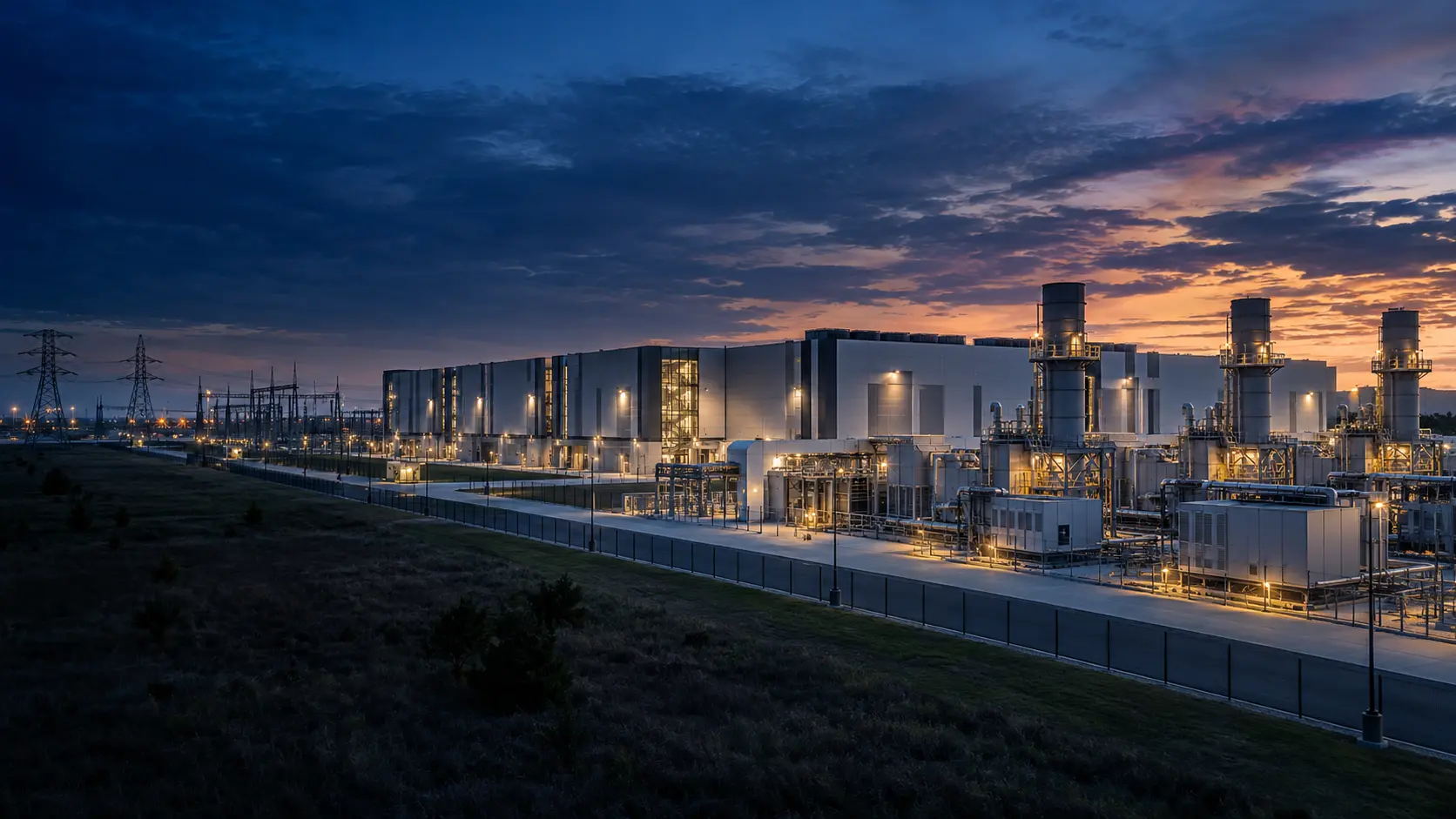
Electricity availability has become a controlling factor in data-center development. The U.S. Department of Energy reported that data centers consumed about 4.4 percent of U.S. electricity in 2023 and could account for approximately 6.7 to 12 percent by 2028. The same report identifies onsite generation and storage as part of the response to rising demand.1
For a developer, the practical question is whether the planned grid connection can support the required load on the commercial schedule. When utility service, transmission upgrades or interconnection studies extend beyond the target date, a phased onsite power strategy may reduce schedule exposure. That strategy is commonly described as bridge power.
What Bridge Power Means
Bridge power is a project-specific plan for serving an initial or expanding load while permanent utility capacity is being developed. It may combine onsite gas generation, battery energy storage, electrical balance of plant, controls and a later grid interconnection. The system can be designed for temporary service, long-term parallel operation, island operation or conversion to another role after utility capacity becomes available.
A Phased Energization Model
- Qualification and feasibility. Confirm site control, target load, energization date, gas availability, electrical requirements, permitting path and utility-discussion status.
- Initial onsite service. Install a right-sized generation block with the required switchgear, protection, controls and fuel infrastructure. Add BESS when the operating case supports fast response, ride-through, reserve support or black start.
- Expansion or conversion. Add generation and storage in modules as load becomes firm. When utility service arrives, evaluate parallel operation, standby duty, peak management or continued onsite baseload.
Why Modularity Matters
Data-center load often arrives in stages. A modular plant can align capital deployment with contracted or forecast load, but modularity does not remove engineering complexity. Each stage must account for fault current, protection coordination, synchronization, grounding, harmonics, controls, fuel pressure, emissions, maintenance access and spare capacity.
GE Vernova describes the TM2500 as a mobile aeroderivative package that can scale in roughly 37 MW blocks and cites an approximate 14-day installation period for the turbine package.2 That manufacturer statement is not a complete project schedule. Procurement, civil work, gas and electrical infrastructure, permitting, commissioning and local approvals can take substantially longer.
The Role of Battery Storage
BESS can complement generation, but its value must be defined through an operating study. Depending on the design, storage may support rapid load changes, power quality, reserve reduction, generator optimization, ride-through, black start and transition between operating modes. The required MW, MWh, inverter capability and redundancy depend on the duty cycle and reliability target.
Safety and permitting must be addressed early. The Department of Energy identifies codes and standards, permitting, insurance, reliability and safety as central parts of storage deployment.3
Five Decisions That Determine Viability
- Is the load real and financeable? Match equipment to a credible development schedule, site control and identified customer or offtake path.
- Is the fuel path bankable? Confirm pipeline proximity, pressure, volume, connection cost, curtailment terms and gas quality.
- Can the project be permitted? Air emissions, noise, water, fire safety, zoning and community requirements can shape technology choice.
- Can the electrical system support the operating modes? Address islanding, synchronization, protection, grounding, black start, UPS interaction and utility integration.
- Who carries delivery and performance risk? Define equipment condition, testing, warranty, logistics, site acceptance and responsibility boundaries.
How Danny O Ventures Supports Qualified Projects
Danny O Ventures helps qualified developers organize the commercial and equipment work needed to evaluate a critical-power pathway. Depending on the project, our scope can include preliminary requirement definition, equipment-sourcing support, coordination of gas-turbine and BESS options, electrical-equipment sourcing, partner engagement and commercial introductions.
Specialized technical services may be coordinated through strategic partners, including Green Grid Technology where appropriate and confirmed. Equipment availability, schedules and commercial terms remain subject to diligence, seller confirmation, site conditions, permits and executed agreements.
Frequently Asked Questions
Can bridge power eliminate the utility interconnection process?
No. Bridge power may serve load before permanent utility capacity is ready, but utility coordination, permits and electrical studies may still be required.
Is onsite gas generation only temporary?
Not necessarily. A plant may later provide baseload, standby, peak-management or grid-support service, depending on permits, economics and interconnection rights.
Does every data center need BESS?
No standard configuration fits every project. Storage should be sized for defined services such as ride-through, fast reserve, black start, power quality or load management.

Houston-based commercial and project-development leadership for critical-power and energy-infrastructure opportunities.
Sources
- U.S. Department of Energy, Electricity Demand from Data Centers, December 20, 2024.
- GE Vernova, TM2500 Aeroderivative Gas Turbine.
- U.S. Department of Energy Office of Electricity, Energy Storage.