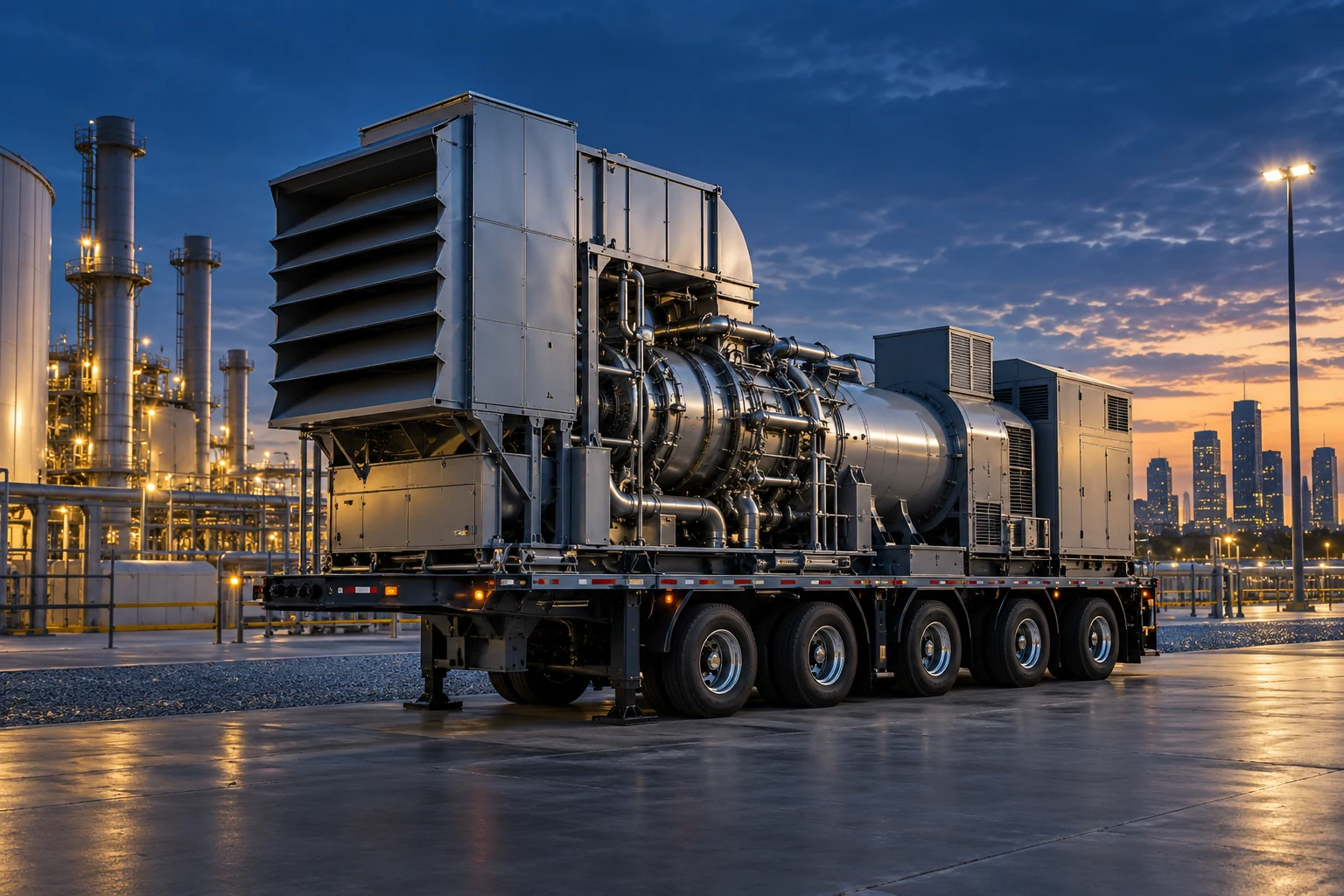
Behind-the-meter generation is receiving more attention as data-center developers confront large loads, demanding uptime requirements and uncertain utility schedules. Gas turbines can provide compact, dispatchable generation, but technology selection should follow the project's operating requirements and permitting limits.
The International Energy Agency's Energy and AI report describes electricity as a central constraint and input for data-center growth.1 That demand supports interest in onsite generation, but it does not remove project-specific diligence.
Common Gas-Turbine Pathways
| Pathway | Typical project fit | Primary diligence questions |
|---|---|---|
| Mobile aeroderivative | Rapid or phased power where compact installation and mobility matter | Equipment condition, emissions configuration, fuel pressure, balance of plant, transport and commissioning |
| Packaged aeroderivative | Longer-term simple-cycle or combined-cycle applications | Lead time, service agreement, hot-day output, maintenance interval and inlet/exhaust design |
| Industrial frame | Larger permanent plants with stable baseload | Project schedule, foundation and lifting needs, start profile, emissions controls and heat recovery |
| Reciprocating-engine alternative | Smaller modular blocks and high unit-count flexibility | Footprint, maintenance intensity, methane slip, noise and unit-count complexity |
Rated Output Is Not Site Output
OEM ratings are normally stated at defined reference conditions. Actual output and heat rate vary with ambient temperature, elevation, humidity, fuel composition, inlet and exhaust losses, degradation and auxiliary loads. GE Vernova's TM2500 specifications state that actual performance varies with project conditions and that balance-of-plant equipment is excluded from the published rating.2
A developer should request a site-specific estimate stating gross and net output, expected auxiliary consumption, heat rate, emissions assumptions, degradation basis and performance tolerance.
Fuel Is a Project Workstream
Natural-gas proximity does not establish fuel availability. The project must confirm the interconnecting pipeline or local distribution company, pressure, volume, gas composition, firm or interruptible service, construction cost, delivery schedule and curtailment exposure. Compression, filtration, heating, metering and pressure regulation may be required between the gas connection and turbine.
Dual-fuel capability may improve resilience where permitted, but it adds storage, logistics, emissions and operational requirements. GE Vernova offers TM2500 configurations with fuel flexibility that can include gas, LPG or distillate, depending on configuration.2
Air Permitting Must Start Early
Stationary combustion turbines are regulated sources. The U.S. Environmental Protection Agency identifies nitrogen oxides and sulfur dioxide among regulated pollutants and points to federal New Source Performance Standards for applicable units.3 State implementation plans, local air-district rules, operating hours, startup emissions and control-technology requirements can materially affect schedule and cost.
Balance of Plant Defines the Real Scope
The generator package is only one part of an operating power plant. A complete scope may require inlet filtration and cooling, exhaust systems, emissions controls, fuel conditioning, fire protection, transformers, switchgear, protection and controls, black-start equipment, synchronization, grounding, civil works, buildings, communications, spare parts and maintenance tooling.
For a data-center application, the design must coordinate with UPS systems, standby architecture, critical and noncritical buses, protection zones and the facility's sequence of operations. The power plant and data-center electrical systems must be engineered as one operating system.
Procurement Diligence for New and Secondary-Market Equipment
- Confirm legal title, seller authority and chain of custody before sharing deposits or confidential information.
- Verify model, serial numbers, operating hours, starts, preservation records, maintenance history and storage conditions.
- Identify the exact package boundary, including generator, trailers or modules, switchgear, transformers, auxiliaries, tools, spares and documentation.
- Obtain an independent technical inspection and define appropriate acceptance testing.
- Confirm OEM or qualified service support, warranty status, parts availability and recommissioning cost.
- Build a logistics plan covering origin, disassembly, lifting, transport, import requirements, insurance and receiving-site readiness.
Commercial Structures
A project may purchase equipment directly, procure an EPC-wrapped plant, lease generation or contract for delivered power. Each option assigns capital, fuel, performance, availability and residual-value risk differently. Compare full delivered cost, capacity payments, fuel risk, maintenance reserves, taxes, insurance, decommissioning and post-bridge equipment value.
How Danny O Ventures Supports Equipment and Project Coordination
Danny O Ventures supports qualified buyers and developers with requirement definition, equipment-market screening, commercial introductions, preliminary package comparison and coordination of complementary electrical equipment. Available inventory and seller details are handled through controlled diligence and remain subject to confirmation.
Where additional technical services are required, Danny O Ventures can coordinate with strategic partners, including Green Grid Technology where appropriate and confirmed. Final engineering, OEM commitments, EPC scope, warranties and performance obligations must be documented by the responsible contracted parties.

Commercial coordination for gas-turbine, storage and electrical-infrastructure requirements serving qualified critical-power projects.
Sources
- International Energy Agency, Energy and AI, published April 10, 2025.
- GE Vernova, TM2500 Aeroderivative Gas Turbine.
- U.S. Environmental Protection Agency, Stationary Gas and Combustion Turbines Standards.