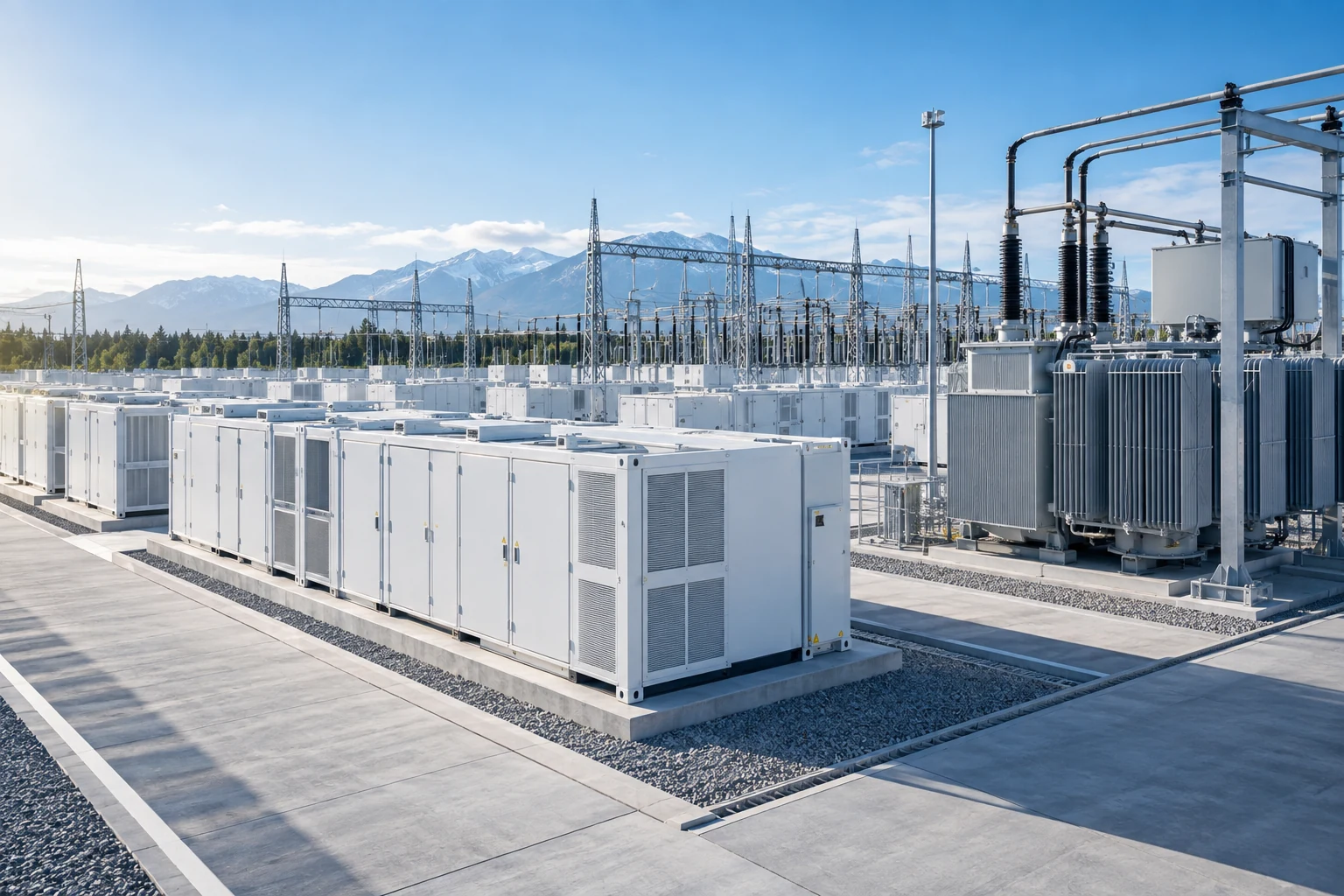
A battery sized for seconds of ride-through is a different asset from one designed for peak reduction, generator reserve or extended island operation. The Department of Energy identifies energy storage as an important resource for future grid demand and emphasizes reliability, safety, performance validation, codes, permitting and insurance.1
For data centers, those considerations must be integrated with the facility's uptime architecture and the operating characteristics of onsite generation.
Services BESS Can Provide
| Service | What the BESS does | Design implication |
|---|---|---|
| Ride-through | Supports critical buses during a short disturbance or transfer | High-power response, controls coordination and defined duration |
| Fast reserve | Responds while generation starts, ramps or recovers | Power rating, state-of-charge reserve and repeat-event duty |
| Load management | Charges and discharges to reduce peaks or smooth rapid changes | Energy duration, cycling profile and degradation model |
| Black start | Energizes selected auxiliaries or buses without an external source | Grid-forming capability, protection and startup sequence |
| Generation optimization | Keeps engines or turbines closer to efficient operating ranges | Dispatch logic, fuel economics and maintenance impact |
| Grid services | Provides services allowed by interconnection and market rules | Metering, telemetry, operating rights and revenue assumptions |
Start With the Duty Cycle
BESS sizing should begin with a time-series model of load, generation and operating events. The study should identify required power in MW, usable energy in MWh, response time, event duration, event frequency, minimum state of charge, expected cycles and end-of-life capacity. It should also address ambient conditions, auxiliary loads, round-trip losses and inverter limits.
BESS and UPS Have Different Roles
A data-center UPS protects critical IT load and maintains power quality through defined disturbances and transfers. A site-level BESS may operate at another voltage level and support broader services, including generation reserve, microgrid stability or energy management. The systems may complement each other, but their controls, protection and failure modes must be coordinated.
The design team should define which asset responds first, which buses remain energized, how long each system must carry load, how generators start and synchronize, and how the site recovers after an event. This sequence should be tested during commissioning rather than assumed from individual equipment specifications.
Hybrid Operation With Gas Turbines
A gas-turbine and BESS hybrid can combine sustained fuel-based generation with rapid inverter response. Depending on design, storage may reduce the need to keep additional generation online solely for fast reserve, assist load pickup, support black start, absorb short load reductions and smooth transitions between island and grid-connected operation.
The economic result depends on fuel price, battery cost, degradation, turbine operating limits, maintenance intervals and the value assigned to reliability. A control philosophy should be developed with OEMs, the engineer and operator so that battery dispatch does not create prohibited turbine conditions or undermine reserve margins.
Safety and Permitting
Battery projects require early coordination with the authority having jurisdiction, fire officials, insurer, utility and site-safety team. Applicable codes and standards may address equipment listing, spacing, fire detection, ventilation, explosion control, emergency shutdown, water supply, access, signage, monitoring and emergency response.
Technology selection should consider cell chemistry, enclosure design, thermal management, propagation testing, control architecture, cyber security, warranty, augmentation and end-of-life obligations. The lowest initial price may not provide the lowest lifecycle cost or best insurability.
Commercial and Technical Diligence
- Define the required services and rank them by importance before requesting quotations.
- Request guaranteed beginning-of-life and end-of-life performance under the expected duty cycle and environmental conditions.
- Confirm usable energy, duration, state-of-charge limits, degradation, availability and auxiliary consumption.
- Review inverter grid-forming or grid-following capability, short-circuit contribution, protection interfaces and communications.
- Evaluate fire-safety evidence, certifications, test reports, emergency response, warranty exclusions and insurance requirements.
- Define integration responsibility among the BESS supplier, generator supplier, EPC, controls provider, utility and data-center electrical team.
How Danny O Ventures Supports BESS and Critical Power
Danny O Ventures supports qualified projects with preliminary requirement development, sourcing coordination and commercial introductions for BESS, gas-turbine generation, switchgear, UPS systems and transformers. We help organize the information needed for technology providers and project partners to evaluate a real requirement.
Specialized technical support may be coordinated through strategic partners, including Green Grid Technology where appropriate and confirmed. Final design, code compliance, warranties, controls integration and performance obligations remain with the contracted engineering, equipment and construction parties.

Commercial and project-development coordination for BESS, gas-turbine generation and critical electrical infrastructure.
Source
- U.S. Department of Energy Office of Electricity, Energy Storage.